You can buy firewalls, EDR and monitoring — but you cannot buy the moment an employee hesitates before clicking a suspicious link, or picks up the phone to report something odd.
That hesitation is culture. In most real incidents, it matters more than any single product.
Key takeaways
- Culture beats policy: if the secure path is slower, people route around it.
- Five pillars: leadership by example, few clear rules, no-blame reporting, short training, measured behavior.
- Every point of friction you remove converts a policy into a habit.
Why culture beats policy documents
Every organization has a security policy. Very few have employees who follow it when it conflicts with getting work done — shadow IT, shared passwords, files forwarded to personal email.
A working culture makes the secure way the easy way, not another threat in the employee handbook.
The five pillars
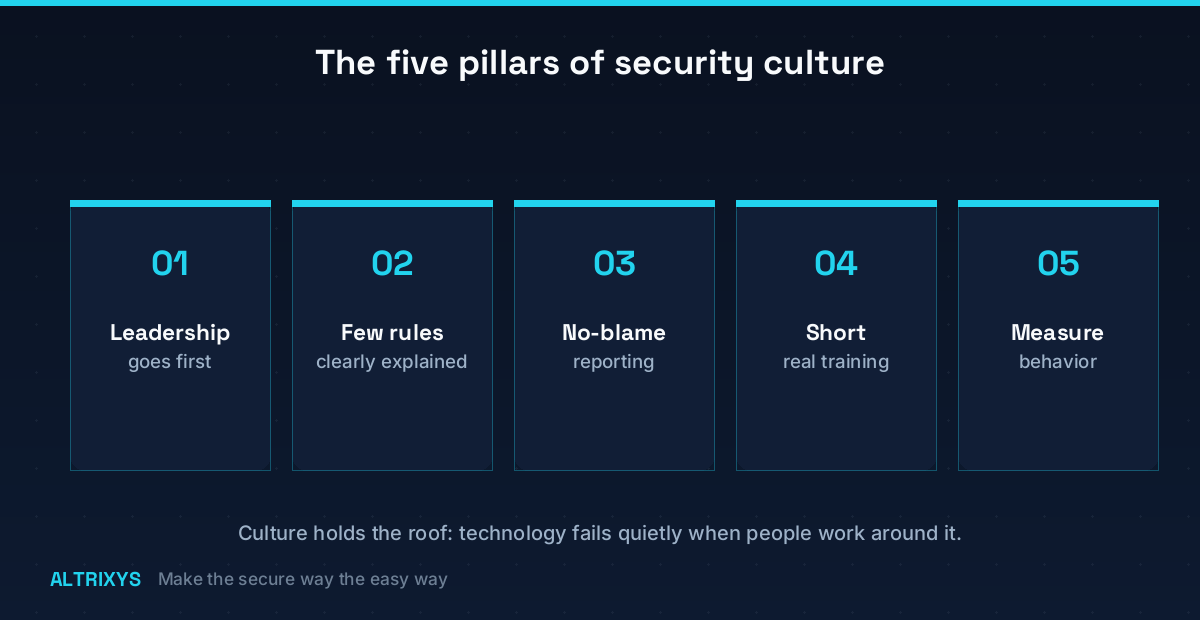
- Leadership goes first. When executives use MFA and sit in the same training, security reads as “how we work here”.
- Few rules, clearly explained. Five practices people understand beat fifty they ignore.
- No-blame reporting. The person who reports “I clicked something bad” within five minutes is your best early-warning sensor.
- Short, realistic training. Ten focused minutes monthly beat an annual compliance marathon.
- Measure behavior, not attendance: click rates, reporting speed, password-manager adoption.
Make the secure way the easy way.
Friction engineering
Deploy a password manager so unique passwords cost nothing. Use single sign-on so MFA happens once, not twenty times a day. Give people a one-click “report phishing” button.
Start small, stay consistent
Pick the two or three highest-impact behaviors — reporting, MFA, password managers — promote them relentlessly for a quarter, measure, and build from there.
Security culture is not a project with an end date. It is maintenance of the human layer of your defenses.
Altrixys provides authorized penetration testing, security hardening and compliance services from Athens, Greece. Want to know how your organization would hold up against a real attack? Request a free assessment.