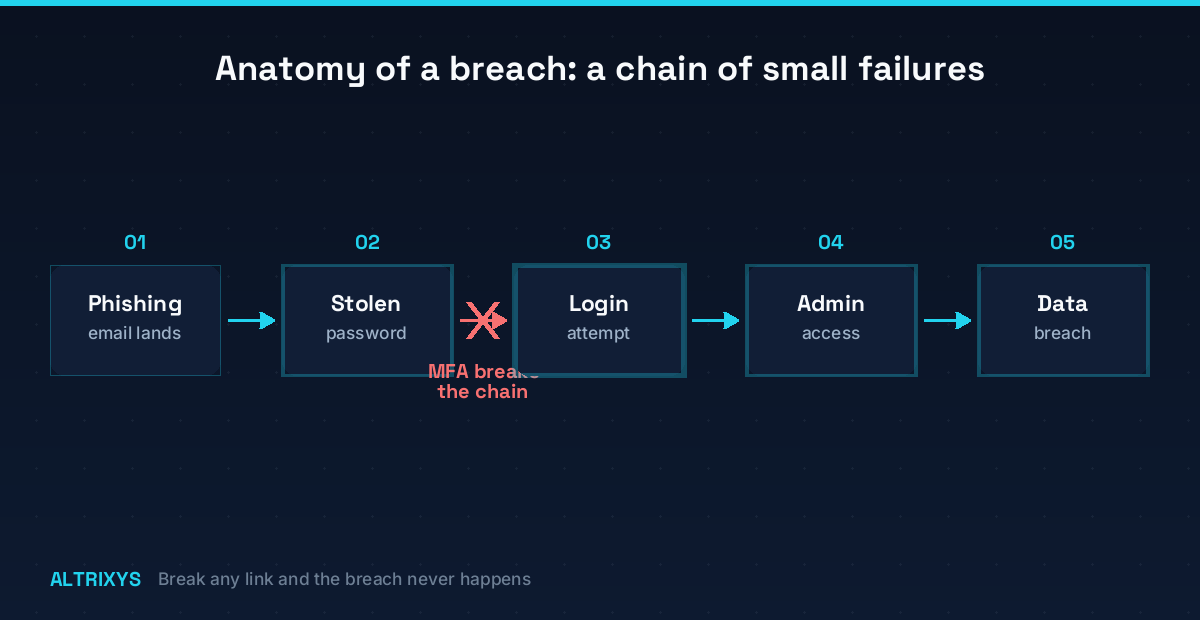
Data breaches almost never come down to a single brilliant hack. They are chains: a phished password, plus missing MFA, plus an over-privileged account, plus nobody watching the logs.
Break any link and the breach does not happen. That is the entire logic of layered defense.
Key takeaways
- Map your data first — you cannot defend what you haven’t inventoried.
- Six layers stop most chains: least privilege, MFA, patching, encryption, segmentation, monitoring.
- Assume prevention will eventually fail — detection speed and tested backups decide the damage.
Know what you are protecting
Start with an honest inventory: what personal, financial and business-critical data you hold, where it lives — servers, SaaS, laptops, backups, third parties — and who can access it.
In our assessments, this exercise alone routinely surfaces forgotten databases and departed employees with active accounts.
The chain — and where it breaks
- Least privilege: people get only what their role requires; admin rights are rare and monitored.
- MFA on everything internet-facing: stolen credentials remain the #1 initial access vector.
- Patching with priorities: exposed systems first, actively exploited flaws immediately.
- Encryption at rest and in transit — lost hardware yields nothing readable.
- Segmentation: a compromised workstation must not have a straight road to the crown-jewel database.
- Monitoring: failed-login storms, unusual transfers and new admin accounts should page a human.
People and vendors are part of the perimeter
Most chains begin with a person — a convincing email, a spoofed invoice, an “IT support” call. Short, regular, realistic training measurably reduces click rates, especially with easy reporting and a no-blame culture.
And remember: your exposure includes every vendor with access to your systems. Third-party compromise is now among the most common breach origins.
Break any link and the breach does not happen.
Assume failure: detection and response
Prevention will eventually miss. What decides the damage is how fast you notice and how well you respond: offline, tested backups; an incident plan that names roles in advance; rehearsals.
Under GDPR, notification deadlines are counted in hours — you do not want to design your process during a live incident.
Finally, test the whole system the way an adversary would. A penetration test walks the actual chain an attacker would use — and tells you exactly which link to fix first.
Related service: Altrixys offers continuous vulnerability management for organizations that want this handled by specialists.
Altrixys provides authorized penetration testing, security hardening and compliance services from Athens, Greece. Want to know how your organization would hold up against a real attack? Request a free assessment.